AI speeds up the work,
people make the call.
In Prozence, AI reads business cards, receipts and shipping labels, summarises voice notes, finds answers in the wiki, translates content and researches customer companies. Below we list what each feature reads, what it produces, what is saved only with your approval and where each piece of data goes.
People and companies in the screenshots are fictional.
Six principles,
the same in every feature.
AI in Prozence isn't a separate chat window; it sits inside the work employees already do, as a reading and suggestion step.
-
It suggests, you save
Readings of cards, badges, receipts, shipping labels and voice notes fill a form; nothing is written until the employee checks and saves it.
- Job changes apply only with "Approve and update"
- Read expenses still go through the approval chain
-
Your company's account and key
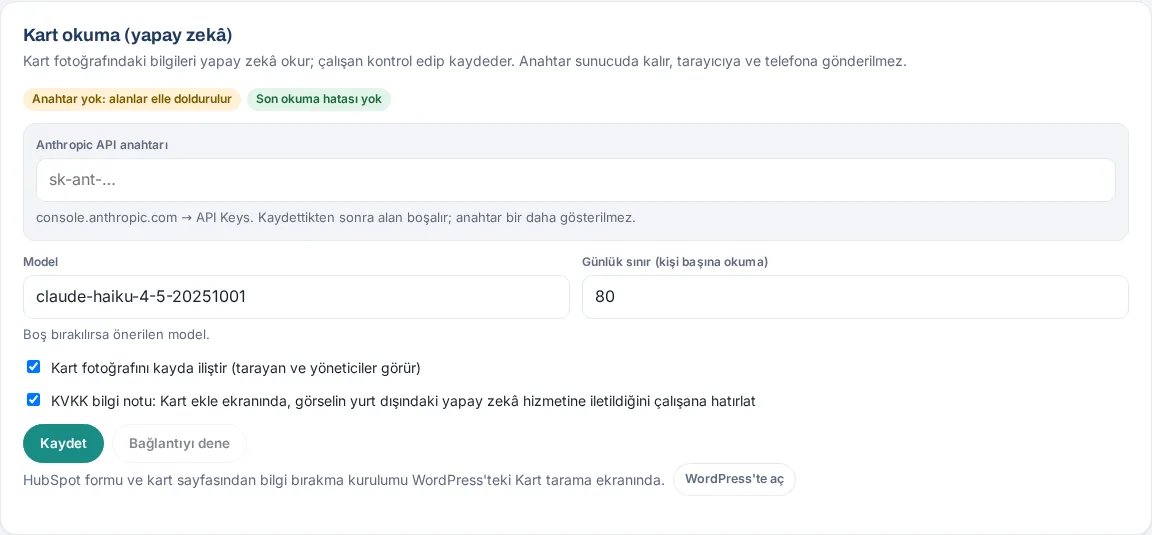
AI runs on Anthropic's Claude models with the API key your company enters on the admin screen. The key stays on the server and is never sent to browsers or phones.
- Default model Claude Haiku 4.5; admins can change it
- "Test connection" runs a real reading of a sample card
-
Only what is needed is sent
Voice notes send only the transcript, Ask the wiki only the relevant sections, and company research only the company name and website.
- E-invoice receipts with a QR code are read on the phone and go nowhere
- Instructions inside content are not followed; they are read as data
-
Switched on feature by feature
Without a key AI is off and everything can be entered by hand. Ask the wiki, translation and the email inbox start switched off; company research and receipt reading can each be turned off.
- If the licence locks, AI stops while business cards keep working
- If credit runs out, admins get one notification a day
-
Limited and counted
Every flow has a daily limit per person and company-wide. When a limit is reached, the employee is moved to manual entry; work doesn't stop.
- The same content is never translated into the same language twice
- If no wiki section is relevant, AI isn't called at all
-
Visible and on record
Company research, translations, wiki answers and voice note suggestions carry an AI note. The add-card screen and the privacy inventory mention the transfer abroad.
- Assessments of people are not sent to the CRM
- Guests' and visitors' business card photos are not stored
A photo of the card,
a checked contact record.
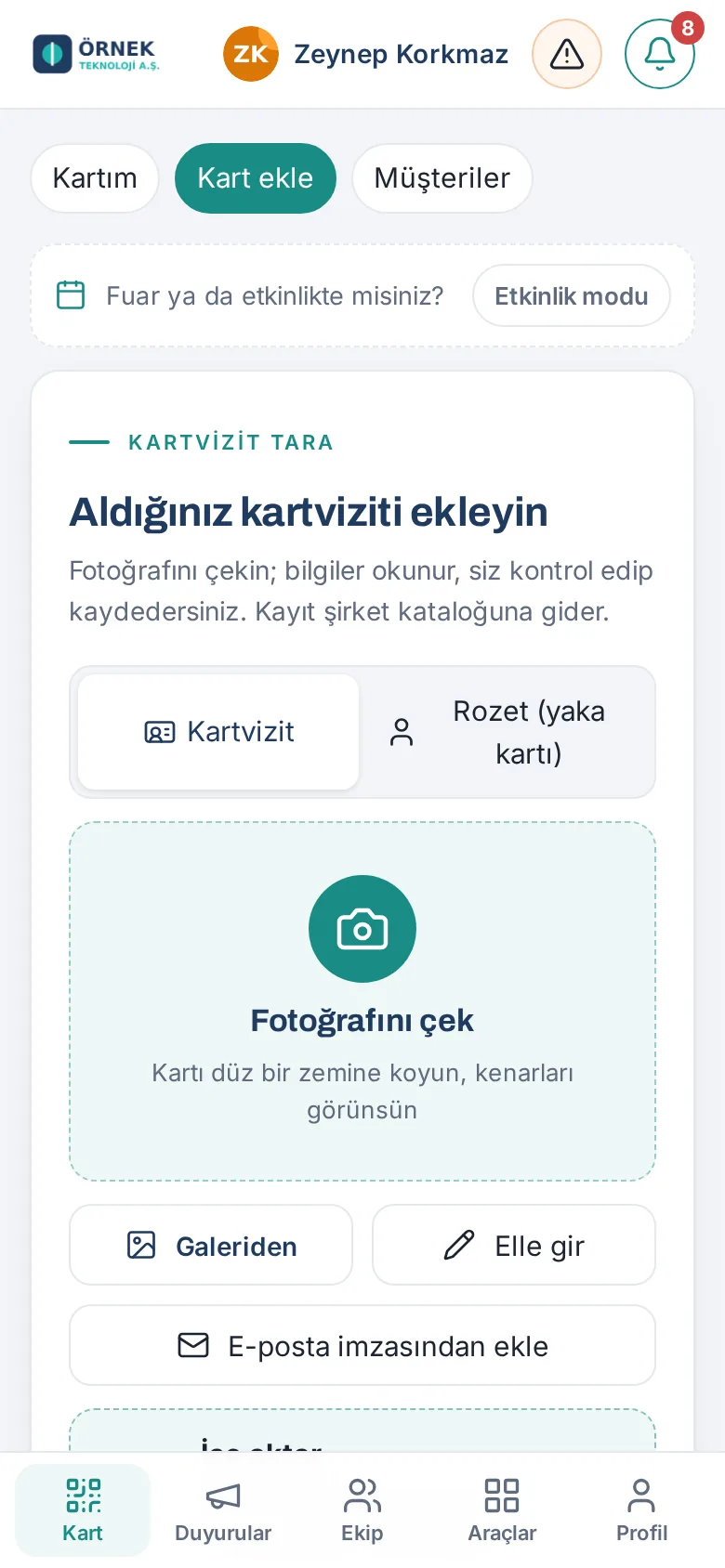
The front and back of a business card, a trade-show badge or an email signature are read; the fields fill a form and the employee checks and saves. Cards photographed sideways or upside down are rotated and read again.
What it reads
Up to two photos (front and back), the text of an email signature and the page behind the card's QR code.
What it produces
11 fields: first name, last name, title, company, email, mobile, phone, website, address, LinkedIn and note; a warning if the reading is uncertain.
QR code first
QR codes containing a vCard or MECARD are decoded without AI; data from the QR code takes precedence over what is read.
Sideways and upside-down cards
AI reports the card's angle; the image is rotated and read a second time.
Doubtful numbers
A Turkish number without 10 digits, or a mobile not starting with 5, is flagged; this check is rule-based.
Trade-show badges
Name, company and title are read; role labels such as "VISITOR" or "EXHIBITOR", the show name and sponsor logos don't count as personal details.
Logo
The company logo on the card is cropped and added to the company record; skip it if you don't want it.
You save
Fields fill the form; the employee corrects and saves. If the person is already in the catalogue, the "Add to my cards" or access request flow starts.
If something goes wrong
Without a key, with no credit left or at the daily limit, the form stays ready for manual entry; employees never see technical errors.
Fine details13 items
Reading rules
- Write only what is on the card and don't guess; keep Turkish characters correct.
- Names written in all capitals are converted to normal case; the company name stays as written.
- Digits are read one by one, watching for mix-ups between 1 and I, 0 and O, 5 and S.
- The person's own email is preferred over a general address; on multilingual cards the main language is used.
- When reading a signature, people and recipients in quoted earlier emails are not mixed in.
Images and privacy
- The phone downsizes the photo to 1600 pixels before reading; up to 4 MB per photo.
- A small copy of the card photo is attached to the record; the person who scanned it and admins can see it, and a setting turns it off.
- The add-card screen says the image may be sent to an AI service abroad.
- Cards photographed without a connection wait on the device; reading happens once online.
- If credit runs out or the key is invalid, admins get at most one notification a day.
The same reading elsewhere
- Visitors leaving their details can photograph their own card; the photo isn't stored, 3 readings per IP per hour.
- "Fill from business card" in the directory's useful addresses.
- Guests' business cards at reception (below).
Speak,
the note and next step are ready.
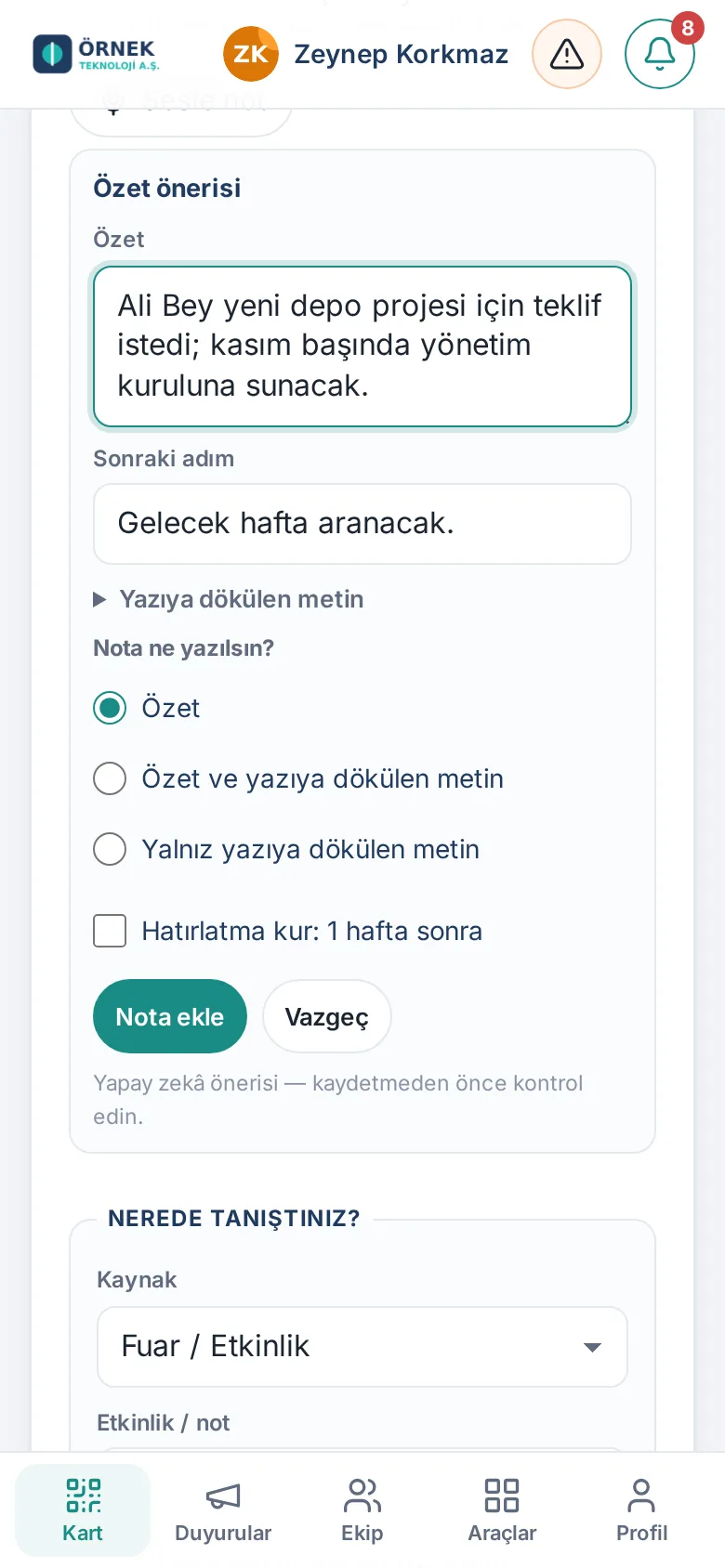
After a meeting, the note is dictated. The browser does the transcription; if you like, AI suggests a short summary and the next step, and you edit them and add them to the note.
Two layers
Speech-to-text is a browser feature; AI only summarises the resulting text.
Summary and next step
A summary of up to 3 lines, a one-sentence next step and a reminder suggestion for 3, 7, 14 or 30 days later.
What goes into the note?
The summary, the summary and transcript, or the transcript only; the reminder is set only if you tick it.
In the language spoken
The summary is written in the language of the conversation; recognition uses the app language.
No customer name
Only the transcript goes to AI; the person's name and company are added only if you tick the box.
Prozence never gets the audio
Audio never reaches the Prozence server; the raw transcript and summary aren't stored unless you add them to the note.
Fine details6 items
Details
- A recording lasts up to 3 minutes; the text is up to 6,000 characters.
- If the browser supports it, recognition runs on the device; otherwise audio goes to the browser's service (Google in Chrome, Apple in Safari, Microsoft in Edge), and this is said on first use.
- The voice note button doesn't appear in Firefox.
- 30 summaries per person per hour; 2,000 a day company-wide.
- Instructions spoken in the conversation are not followed; they are read as data.
- Sending voice note summaries to the CRM as notes is off by default.
Forward a customer's email,
and the contact is added.
Employees forward a customer email to the company's shared inbox; AI finds the external people in it and adds them to the forwarder's directory. A short instruction such as "add the sender only" can be written at the top when forwarding.
With instructions
A short instruction in Turkish or English: "add the person in the signature, note: asked for a quote". Without one, the external people who wrote the email are added.
Filters
The company's own domains, excluded domains, the forwarding employee and people who only appear in the recipient list are not added; up to 5 people per email.
Verified sender
The forwarder must be a published employee and the email must pass DMARC or DKIM; unverified emails are held back.
Saved directly
This route has no review screen: the person is saved, sent to the connected CRM, and the employee is told the result.
Content not kept
Processed emails are deleted from the inbox; the log keeps only the time, forwarder, start of the subject and result.
No AI for vCard attachments
For emails with a .vcf attachment, contacts are read from the file; AI isn't called.
Fine details4 items
Details
- The inbox is read every 5 minutes: Gmail or IMAP (Yandex 360, Zoho Mail and others).
- If reading fails, the same email is tried up to 3 times; after that the employee gets an "Email couldn't be read" notification.
- If the person is in another employee's unshared list, the record isn't touched and an access request is sent.
- It shares the daily per-person limit with card reading.
New customer companies are
researched in the background.
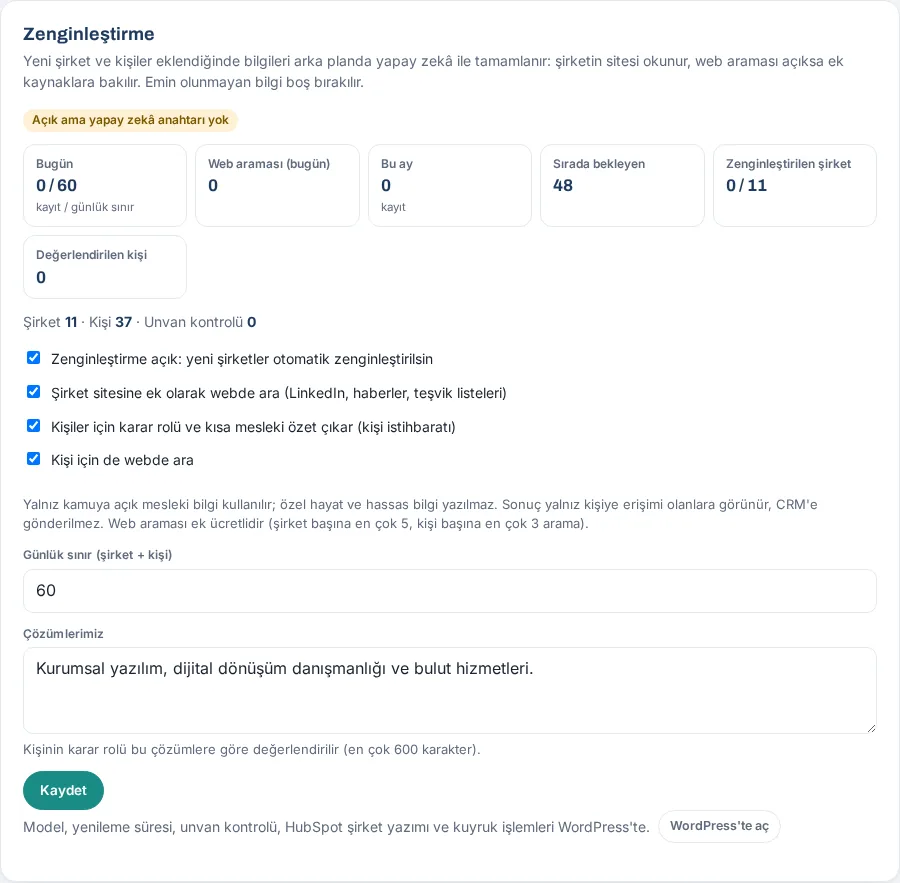
When a new company enters the directory, its own website is read and checked with a web search. Industry, headcount range, headquarters, stock ticker and technology park, R&D centre or incubator status are written to the company card. For people, a decision role is assessed only from public professional information.
Company fields
Website, LinkedIn, headcount range, industry, short description, founding year, headquarters, group or holding, switchboard, address and social accounts.
Made for Türkiye
Borsa İstanbul ticker and incentive profile: technology park, R&D centre, design centre and TEKMER incubator.
Sources and confidence
Up to 6 sources and a high, medium or low confidence for every result; a "Enriched by Prozence AI" note.
Same company?
If AI finds a different company, its result is dropped; only facts read from the website remain.
Only empty fields fill
Manually entered data is never overwritten; only empty website, phone and address fields fill in on their own. If enabled, empty fields of the HubSpot company are written too.
About the person
Decision role (decision maker, influencer, user, gatekeeper), influence, a short professional summary and an approach suggestion; not sent to the CRM.
No sensitive information
Private life, family, health, religion, political views, home address and personal contact details are neither written nor searched for.
Namesake rule
If both name and company don't clearly match, web results aren't used; the person is assessed from the title alone.
Refresh
Information older than 180 days is refreshed (30–730 days); up to 30 records a day are queued.
Fine details6 items
Details
- On by default once a key is entered; enrichment, web search and people assessment can each be switched off.
- Up to 5 web searches per company and 3 per person; web searches are billed separately by the AI service.
- 60 records a day by default for companies, people and job checks together.
- People are assessed against your "Our solutions" text, which your company writes (up to 600 characters).
- In the background, up to 3 records are processed every 5 minutes, with up to 3 attempts per error.
- The company's own domains aren't enriched; results are written in Turkish whatever the interface language.
Was your customer promoted,
or did they move on?
Customer contacts are checked on the web from time to time. If there is a real difference and at least one source, a suggestion appears; the record doesn't change until you approve.
Our own data first
If the same person arrives with a new card, signature or email and a different title, it goes into the history and the card's other owners are told. This step uses no AI.
Web check
Every 180 days by default: same, title changed, company changed, left or unknown; with an explanation and sources.
Suggestion threshold
Suggestions appear only with a real difference, confidence above low and at least one source; a rejected suggestion isn't asked again.
Approve and update
Once approved the record is updated, the new company linked, the old email marked and the change sent to the CRM.
Badges and filter
New title, New company, Left the company; a "Job or company changed" filter in the customer list.
3 searches per person
Up to 3 web searches per check; it shares the daily limit with company research.
Receipts without a QR code
are read too.
When adding an expense, the phone first looks for the Turkish e-invoice or e-archive QR code. Without one, the receipt or PDF is read by AI; the details fill a draft item, the employee checks and submits it, and then the approval chain starts.
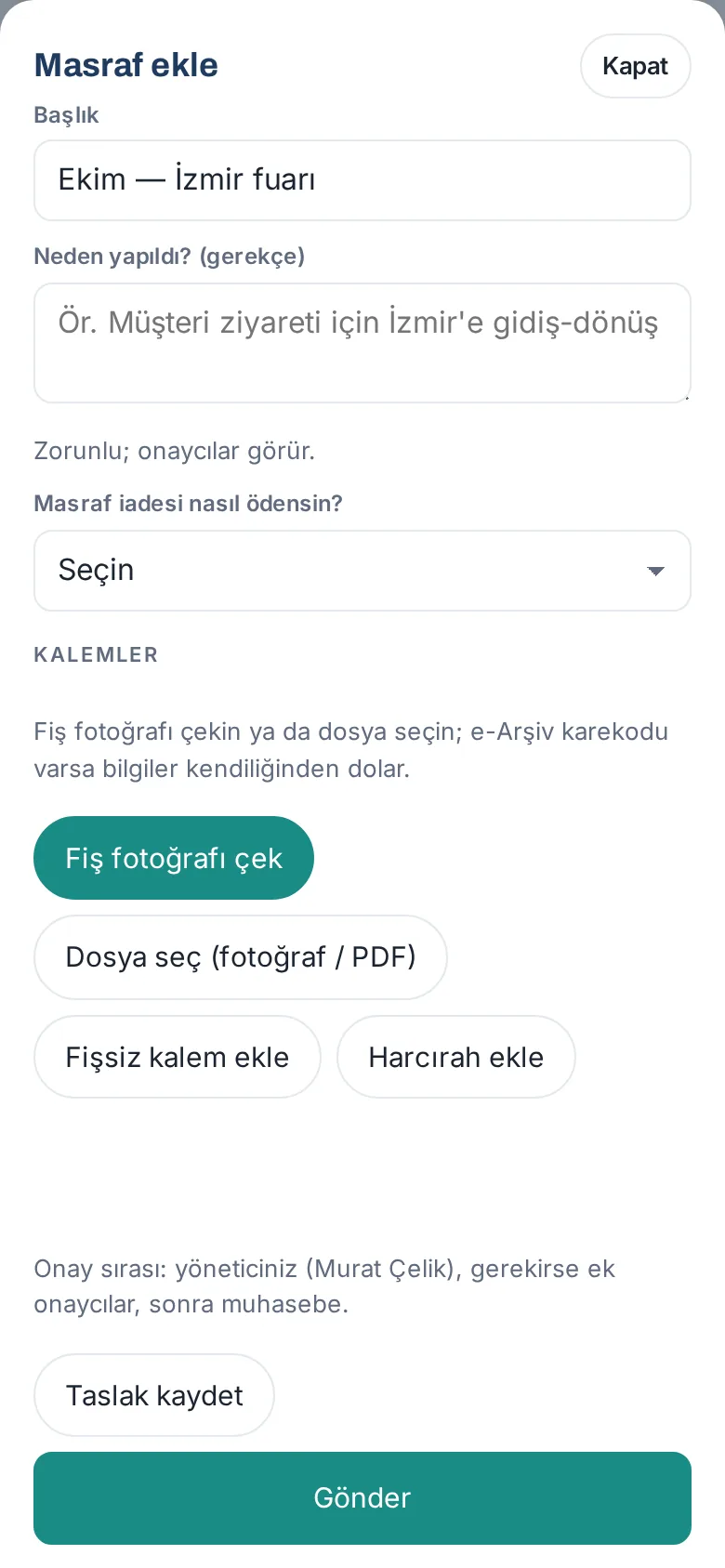
What it reads
Till receipts, taxi receipts, tickets, receipts and foreign invoices; photo or PDF.
What it produces
Vendor, tax number, date, document number, currency, total including VAT, up to 6 lines by VAT rate and a suggested category.
Validation
Future dates, tax numbers that aren't 10 or 11 digits and VAT rates other than 0, 1, 10 and 20 are dropped.
QR code first
Receipts with a QR code are never sent out; the item is marked "verified by QR code".
Checked twice
The employee checks and submits the item; then the manager, extra approvers and accounting approve.
Limits
40 readings per person per day (adjustable); 3,000 a day company-wide.
Fine details6 items
Details
- Currencies TRY, EUR, USD, GBP, CHF, AZN and RUB; the exchange rate doesn't come from AI, the employee enters it.
- A Z report number doesn't count as the document number.
- If the document isn't an expense document or can't be read, a warning appears.
- Without a key, receipts with a QR code are still read; the rest are entered by hand.
- Several receipts in one photo aren't separated; photograph each receipt on its own.
- Receipt images are kept in a private folder for at least 5 years.
The guest's business card,
the parcel's label.
At reception, a photo of the guest's business card is taken; name and company are read and matched with today's expected guests. In the mailroom, recipient, sender, carrier and tracking number are read from the shipping label and the recipient is suggested.
Matching expected guests
Turkish letters and letter case are ignored; a single strong match is selected automatically, otherwise suggestion buttons appear.
Added to the directory
The checked-in guest's card is added once to the directories of the meeting owner and colleagues in the meeting.
Nine types from the label
Parcel, envelope, documents, official notice, courier, food, flowers, bank card and other; the carrier is matched to the name in your list.
Suggested recipient
The name on the label is matched with employees; if there are several candidates, the desk chooses.
Photos
Guests' business card photos aren't stored; a shipping label photo can be added to the record if you wish.
Limits
200 readings per person per day; without a key the photo button doesn't appear and details are typed in.
Announcements written in Turkish,
read in everyone's language.
Announcements, wiki articles and Team square posts are translated into the employee's app language. A translation is made once and kept; "Show original" is always one tap away.
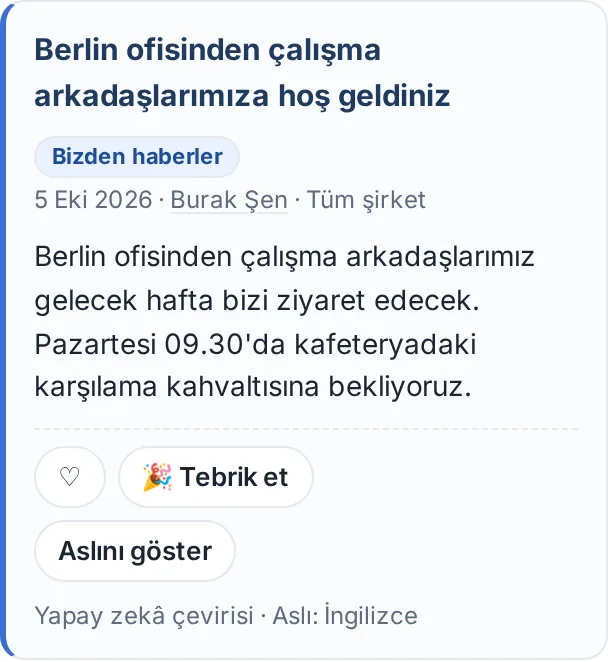
9 languages
Turkish, English, German, Spanish, French, Italian, Portuguese, Russian and Azerbaijani.
Three modes
Off (default), a "Translate" button on content, or automatic for interfaces in languages other than Turkish.
What stays as is
Headings, lists, tables, links, email addresses, numbers, dates and names of people, companies and products.
Translated once
The same content is translated into the same language once, and again only if it changes; showing a saved translation doesn't count towards the limit.
Same permissions
The announcement's audience, the wiki access rule and the post's scope apply to translations too.
Limits
30 new translations per person per hour; 300 a day company-wide (adjustable); content up to 15,000 characters.
Answers only from
articles you can see.
Employees type a question; Prozence first finds the relevant sections in the wiki and, if you wish, in company policies, and gives only those to AI. The answer comes with source links; if nothing is relevant, AI isn't called at all.
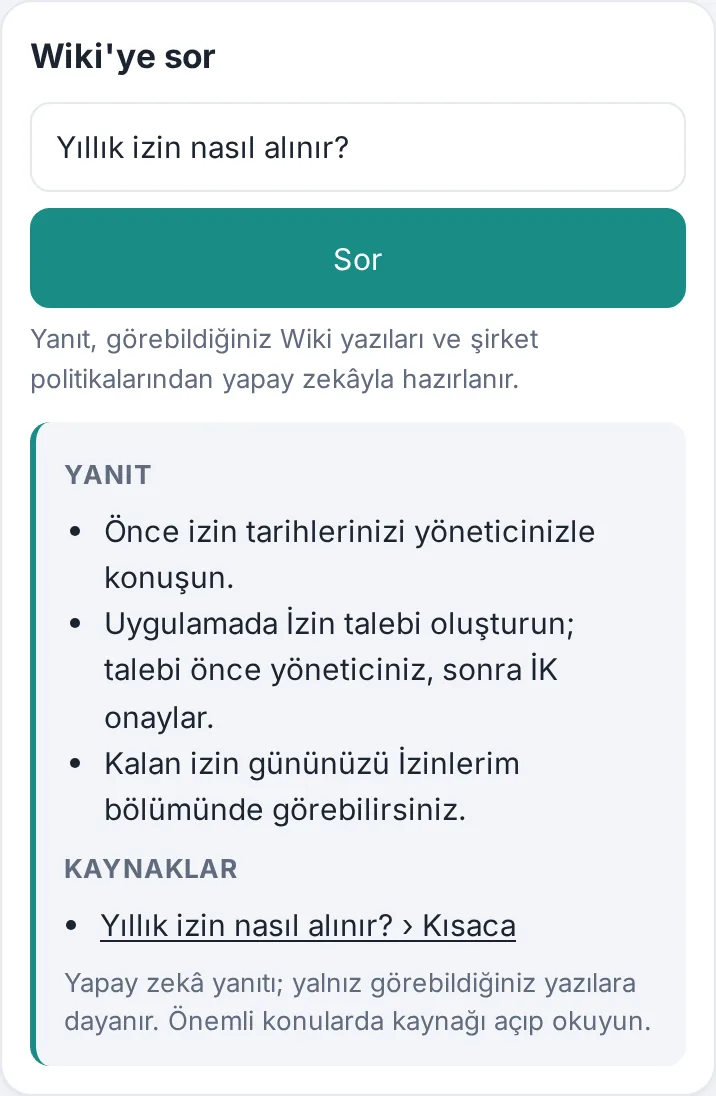
Permissions first
Sources are chosen on the server from published articles the person asking can see; drafts are never sources.
Answers with sources
Article and section links under the answer; they open without reloading the page.
Doesn't make things up
Answers come only from the sources; if nothing is found it says "I couldn't find the answer in the wiki" and suggests a wiki search.
No personal information
Nothing about salaries or other employees that isn't in the sources; instructions in the question aren't followed.
In your language
The answer is in the person's app language; up to 8 bullet points or 3 short paragraphs.
Who asked isn't recorded
Only daily counts are kept; unanswered questions can be kept anonymously for 90 days if you wish.
The guide is a source too
The Prozence user guide imported into the wiki is answered from too; in English in the English interface.
Off by default
An admin switches it on; using company policies as a source is a separate option.
Limits
Questions of 3–300 characters; 20 per person per hour and 200 answers a day company-wide.
Fine details4 items
How sources are chosen
- Articles are split by headings; the terms in the question are looked for in headings, tags and text.
- The best 6 sections, at most 12,000 characters in total, go to AI.
- Selection is keyword-based; asking the same thing in different words can change the result.
- Attachments and announcements aren't sources.
What goes,
what stays.
What is sent with each AI call and what Prozence doesn't keep, feature by feature. The AI service is Anthropic (USA); this transfer is stated in the employee privacy notice and the privacy inventory.
| Feature | Sent to the AI service | Not kept, or never sent |
|---|---|---|
| Cards, badges and signatures | Card image, signature text, text of the page behind the QR code | Visitors' own card photos aren't stored; the small copy of a card scanned by an employee can be switched off |
| Voice notes | The transcript; name and company only if you tick the box | Audio never reaches Prozence; the raw transcript and summary aren't kept unless added to the note |
| Adding by email | The text of the forwarded email and the instruction | The email is deleted from the inbox once processed and its content isn't kept |
| Company and people research | Company name, domain and home page text; the person's name, title and company | Private life and sensitive categories aren't searched; people assessments don't go to the CRM |
| Expense receipts | The image or PDF of a receipt without a QR code | E-invoice and e-archive receipts with a QR code are never sent |
| Reception and mailroom | Image of the guest's business card or the shipping label | Guests' business card photos aren't stored |
| Translation | Announcement, wiki or post text | Translated once and kept with the content; not sent again |
| Ask the wiki | The question and up to 6 relevant sections | Who asked isn't recorded |
Default
usage limits.
Limits count uses; there is no budget cap in money, and actual spending is tracked in the AI service's console. Ranges in brackets are what admins can choose.
| Flow | Per person | Company-wide |
|---|---|---|
| Card, signature and QR reading; adding by email | 80 a day (1–1,000) | No separate cap |
| Voice note summary | 30 an hour | 2,000 a day |
| Expense receipts | 40 a day (0–500) | 3,000 a day |
| Reception and mailroom photos | 200 a day | No separate cap |
| Company and people research | "Refresh" 30 a day | 60 records a day (0–1,000) |
| Translation | 30 an hour | 300 a day (10–5,000) |
| Ask the wiki | 20 an hour | 200 a day (10–5,000) |
| Visitor's own card | 3 an hour and 10 a day per IP | 30 a day per card |
Not every smart feature
is AI.
These look smart but send no data to any AI service, and they work without a key.
- E-invoice and e-archive QR codes: Read on the phone and decoded in the Turkish Revenue Administration format; the receipt goes to no AI service.
- Corporate profile photo: The background is removed in the employee's browser by an open-source model bundled with the plugin; no face recognition, and the original photo never leaves the device.
- Speech to text: The browser's own speech recognition; Prozence never receives the audio.
- Customer company org chart: Rule-based placement into 8 levels and 11 departments from words in Turkish job titles.
- Doubtful numbers and tag suggestions: Digit counts and domain rules; for example, a gov.tr address suggests the "Public sector" tag.
- Trade-show qualification score: The sum of fixed points for the answers staff give.
- Company logo: Taken from the company's own website; no AI is used in this step.
Your workplace's
new common ground.
Bring your people, your brand and your daily work together. Free for 14 days, no credit card.